
Resumes and documents arrive by email, and someone has to open them, copy the data and work out which opening they belong to. Now you forward them to one address and Aindez does that work.
Here's how it works, step by step.
New1 · Forward the email to your organization's address
Each organization has its own email address for enrolling candidates, and your team copies it from the candidates page. Send or copy that address on the email with the person's resume or documents. Aindez creates the candidate, or links it if one with the same email already exists, and ignores repeated forwards.
New2 · Aindez reads and finds the opening
Aindez reads the email and the PDF or image attachments and extracts the candidate's data, not that of whoever forwards it: their ID number and the job they're applying for. With that job it searches your open openings. If there is a single clear match, it creates the application and the document request with that opening's requirements.
New3 · Review what isn't clear
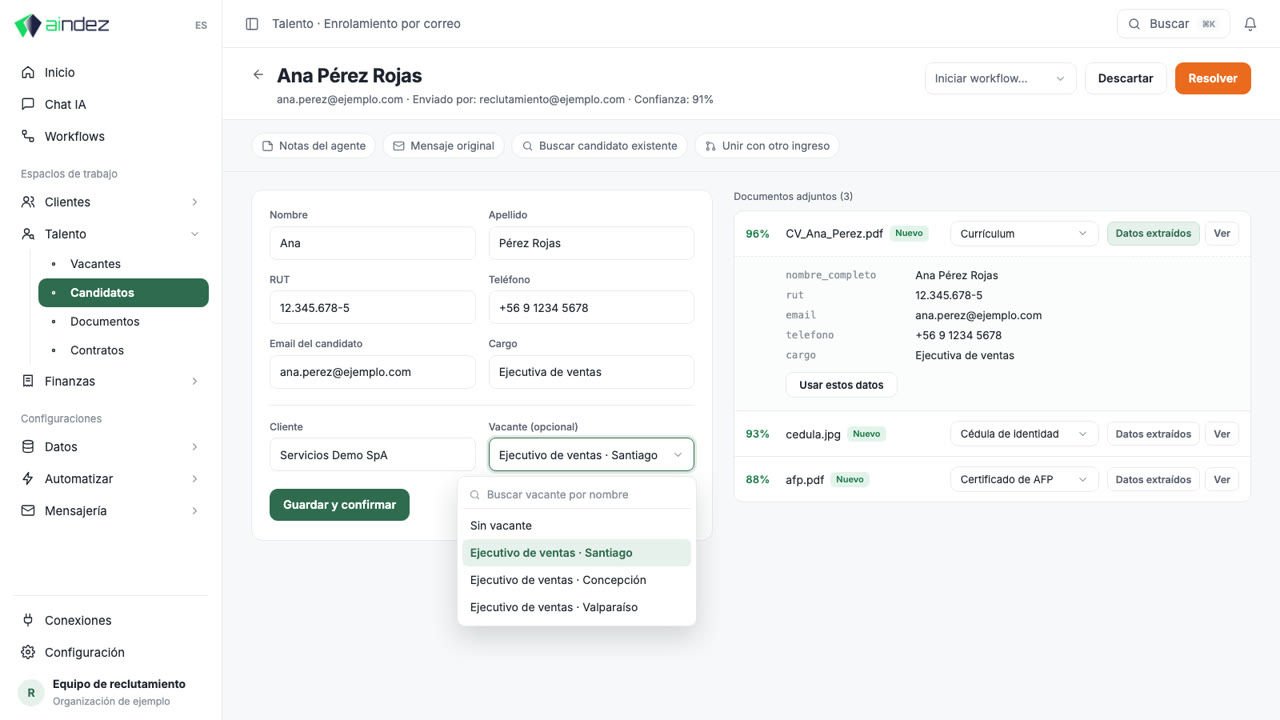
If the result is ambiguous, Aindez doesn't guess: it flags the request for review. A manager in your organization opens it, sees the extracted data and picks the opening, and it creates the same thing the automatic match would have. You can filter requests by status, and one that's already resolved can't be resolved again.
How we do it
- One address per organization, and repeated forwards don't duplicate anything.
- We read the candidate, not whoever forwards.
- We only link when the opening is clear; otherwise, a person decides.
- We never overwrite data you already have.
In technical terms
- Email reaches us through a signed webhook, and the organization is identified by the destination address.
- A vision-capable AI model reads the email and attachments and extracts the candidate's data.
- If reading fails, the request moves on without data and never gets stuck.
- The opening is looked up only among open ones; if there's no clear match, the case goes to review.
- Only empty fields on the candidate's profile are filled; existing data is never overwritten.
Your team stops copying data from an email into another system and only reviews the doubtful cases.