
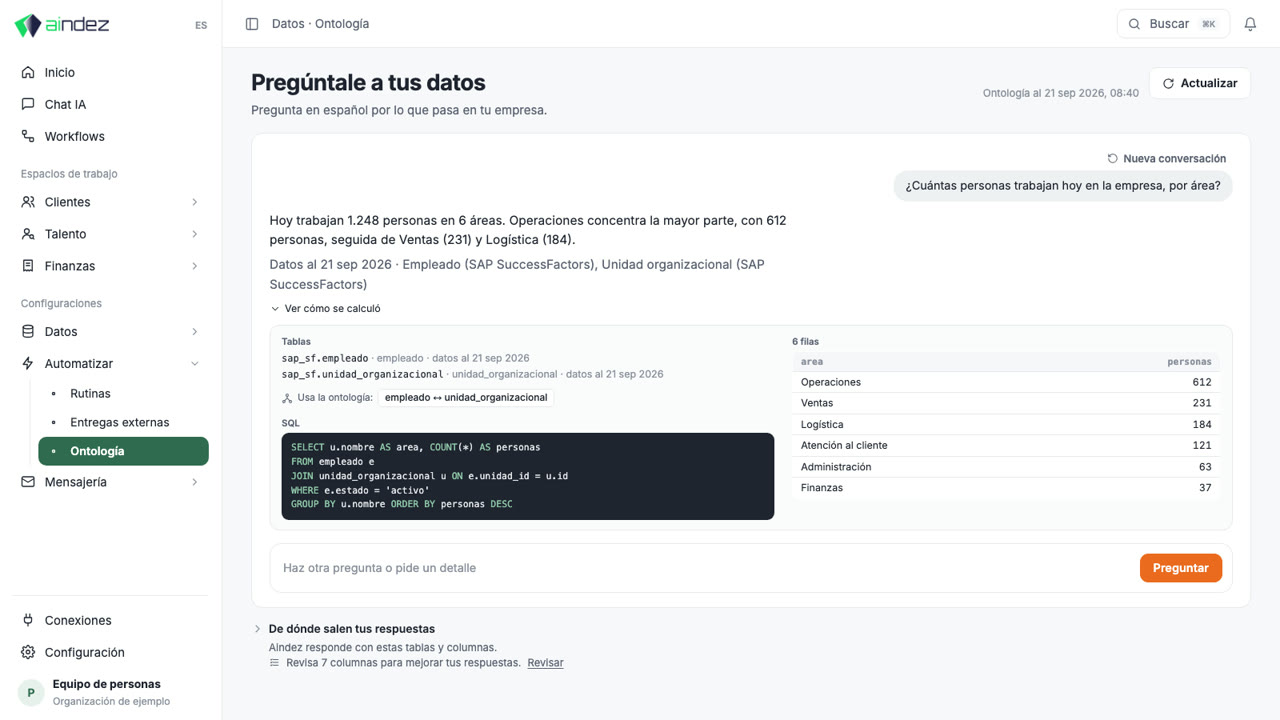
Your data lives in several systems, and each one names the same thing differently. To answer a simple question you need to know which column is which and how the tables connect. Aindez now works that out for you, and your team confirms.
Here's how it works, step by step.
New1 · Aindez identifies what each column is
The Ontology page, inside Data, gathers the tables from your connectors and from Aindez and assigns each column a concept: amounts, invoice numbers, dates, bank details, among others. You confirm, correct, or mark the column as outside the vocabulary. Your decision is saved and respected when Aindez analyzes your data again.
New2 · Review how your tables relate
Aindez detects what each table is about and which table each column points to, and draws those relationships in a diagram. From a table's record you confirm, reject or restore a relationship. Only confirmed ones are used to combine tables, and every answer says which ones it used.
New3 · Every table with a description
Aindez AI writes one or two sentences about what each table is. They are only published if they pass a verification; if not, the table shows "No description" instead of a doubtful text.
New4 · Ask in plain language
In "Ask your data", in the chat, or with the aindez bi command from the terminal, you ask business questions about your tables. All of them read the same knowledge. If there are no results, the answer tells you how far the queried data reaches.
How we do it
- Your decision wins: a new analysis never overrides it.
- If we're not sure, we don't publish it.
- Every answer shows where it came from.
- Personal data doesn't reach the model that writes the answer.
In technical terms
- Each column is classified against a vocabulary of concepts; if confidence isn't high enough, it stays in a broader category.
- We first classify with column names and types; samples are only sent when needed, and never from personal data.
- Every classification is stored so it can be audited, and a human confirmation is never overwritten.
- When answering, the model only sees tables you can read; when in doubt, personal data is hidden.
- Every answer shows its trace: which tables it came from and which SQL query produced it.
You get faster, more consistent answers without asking anyone to build a query by hand.