
Buk presented Buk Studio on November 4 in a fifty-minute webinar for its customers, with a live demo and a Q&A. The recording is on YouTube, in Spanish.
This post covers the launch in detail. The comparison with Aindez is in AI agents, whatever HR system you use.
Why a new pillar
Buk operates in Chile, Peru, Mexico, Colombia and Brazil, and says 3,500 customers already automate processes on its platform. To its five pillars, administration, organizational development, benefits, finance and platform, it now adds a sixth: AI and automations.
Daniel Malov, from product, explained why: today "a chatbot alone is not enough" (min. 7:44). The pitch has three ideas:
- Configure once and let processes move on their own.
- A human approves what's critical. The AI doesn't make decisions that could harm the company.
- AI on processes that are already connected. It lives where the hiring, onboarding, attendance and payroll data is.
The three layers
Buk AI comes included, with more than twenty features:
- Assist: explain a payslip, help people use the platform or recommend courses.
- Analyze: résumés, survey results, the tone of comments and AI filters.
- Create: templates, emails, courses and feedback.
Expert Agents. Buk trains and maintains them, and each company activates them from a marketplace.
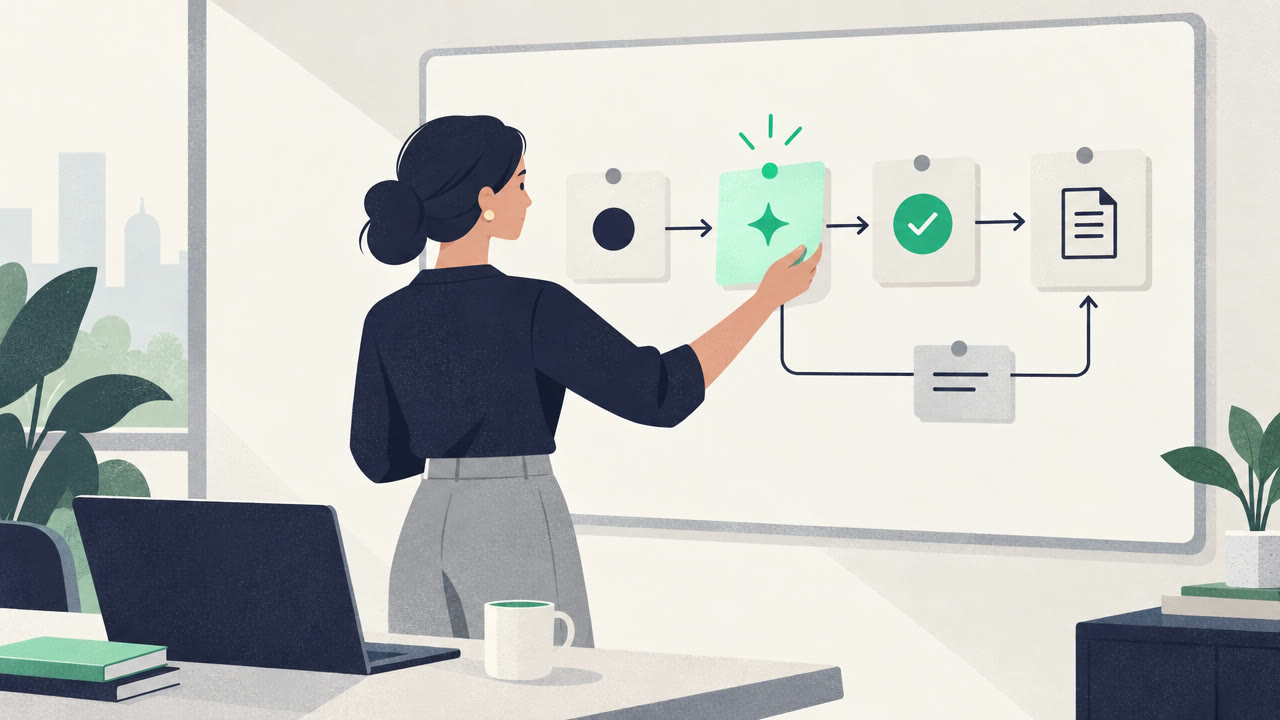
Buk Studio. Each company builds its own flows and agents, with AI between the steps.
How Buk Studio works
Flows take a process that already exists and organize it inside Buk. There are two kinds:
- Approval flows, such as salary raises, hires, departures or paid courses. Matías Zenteno, Product Manager for Workflows, said many companies handle them "by email, by WhatsApp", or even in person.
- Automations, which start from an event and run an action. Events include someone joining, changing role, updating their personal data or passing a course. Actions include assigning a document, a bonus, a deduction, an asset, a task, a survey or a course.
Over time, flows also show which areas or people slow approvals down.
Agents have a name, a description and a plain-language instruction, "just like when you write to ChatGPT". They run on the schedule you set, report to HR and remind each person of what they have pending: documents, reviews, surveys or onboarding tasks.
Every flow and agent keeps a log of what it did. And an agent has the same permissions as the user who sets it up.
The three demos
Matías Zenteno built three cases live.
1. Salary raise with approvals (min. 21:33). He started from a catalog template. The form asks for the person, the date and the new base salary. HR approves first and then the general manager, but a rule skips the manager if the raise is under 10%. Before HR, an AI stage summarizes the person's performance reviews and gives arguments for and against.
2. Automatic contract at hiring (min. 27:58). When an employee's job is created, the flow generates their contract. You can add an approval and a rule so it only runs for one area, for example with one contract for management and another for operations.
3. Follow-up agents (min. 31:49). One agent found six people in marketing with more than twenty days of accrued vacation. Another found six people in operations with seven unsigned documents. The idea for that one came from a comment in the chat. He showed how to have it email each person every day until they sign, but didn't send it during the demo.
The Expert Agents marketplace
| Agent | Status | What it does |
|---|---|---|
| Employee | Available | Answers questions, manages vacation, balances and leave, and explains payslips and documents |
| Tutor | Available | Supports the person while they take a course |
| Benefits | Available | Reviews each request, validates documents and eligibility, and proposes approving or rejecting |
| Pre-screening | Available | Evaluates résumés in bulk and recommends approving, rejecting or reviewing |
| Process Auditor | Coming soon | Audits payroll and detects anomalies |
| Contact | Coming soon | Makes first contact with candidates in a hiring process |
What it answered in the Q&A
- Contracts and addenda: a flow can generate any document that exists as a template in Buk. If it's external today, it has to become a template.
- Signatures by role: you can assign a role as signer, for example the manager of each work site. That's what they recommend for large companies.
- Access to Buk Studio only: you can create a profile so, for example, IT can test flows and agents, as long as it has permissions on the modules it will touch.
What it admitted it doesn't do yet
Every honest answer describes a real problem their customers have:
- The AI extracts data from the document, but can't use it to create the employee record. They called it "top priority" (min. 45:56).
- A flow has a single action. To approve a salary change and generate the addendum you chain two flows (min. 42:46).
- One flow per contract type. They don't yet pick the template by role or area (min. 45:28).
- Notifying Chile's labor authority (Dirección del Trabajo) with the signed contract, addendum or termination. "We started working on it at the end of last week" (min. 47:50).
- Agents don't handle variables. And what the employee-facing agent answers can only be limited indirectly, through the documents you upload (min. 44:31 and min. 41:55).
Pricing and guarantees
Buk Studio is already live for every customer, in the left-hand menu. It isn't a demo: it works in full. Every plan includes one active flow and one active agent. You can create and test as many as you want, but having more than one active requires buying the module.
Buk just certified its AI under ISO/IEC 42001. It said it has 350 developers improving the product every day, and that its vision is for there to be "no limit" to what can be automated.
And everything happens inside Buk: "we don't need external tools, because we use all of that to feed Buk Studio".
Buk Studio organizes what happens inside Buk very well. What happens between Buk and your other systems is still yours to solve.
Sources: Buk Chile's webinar "Conoce nuestro nuevo pilar", November 4, 2026, and its recording on YouTube; pages for Buk Studio and Workflows. Quotes are from the recording, translated from Spanish.
Get the Aindez blog in your inbox
Get every new post in your inbox.

Manuel Vallejos · Founder and CEO of Aindez, the AI orchestration layer for companies that manage employment at scale.

Claude Opus 5.5 · Anthropic's AI model. Co-author of this post: it researched the sources, organized the data and drafted text that Manuel reviewed.