
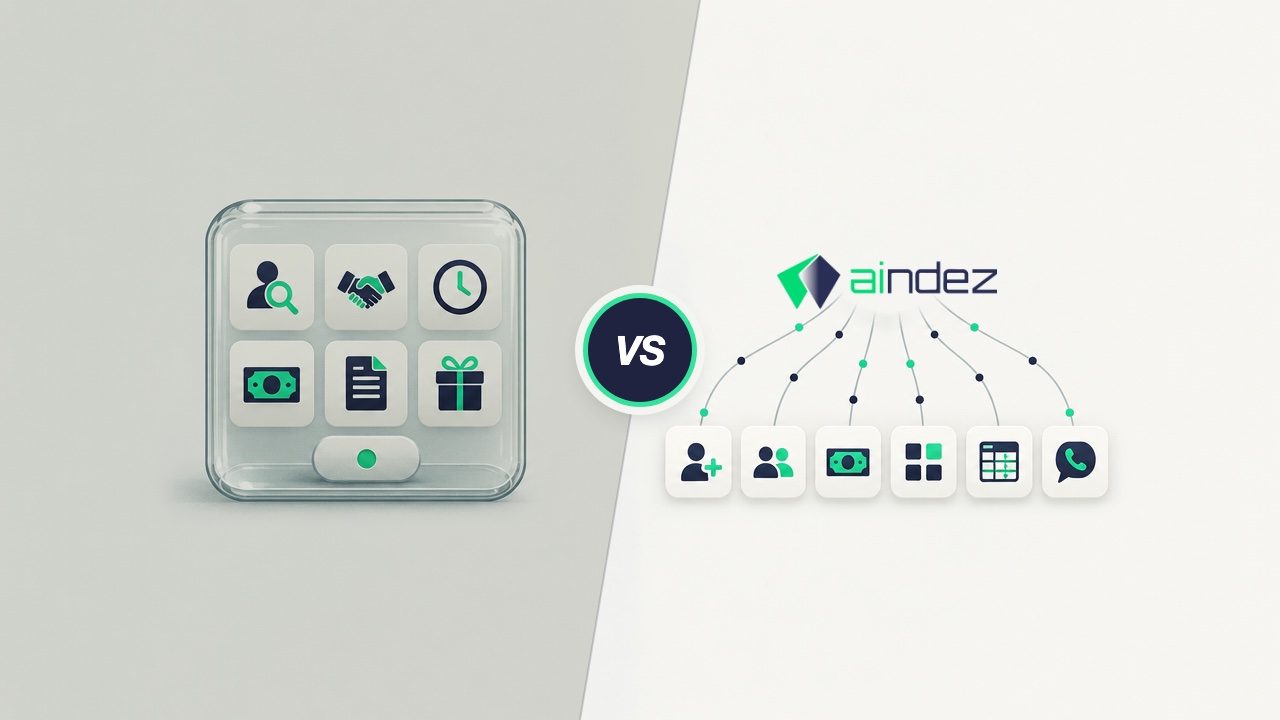
This week, two of the leading HR platforms in the Spanish-speaking market launched their AI agents: Buk presented Buk Studio and Factorial the new version of One.
For those who think building AI in is a weekend with an API, these launches come a year and a half after OpenAI released its tools so that anyone can build agents.
Factorial raised 150 million dollars this June and Buk, 50 million in January 2025.
Buk has 390 developers and Factorial, more than 200 product engineers. Even so, bringing agents into their product took them months.
How they describe themselves
Both promise the same thing in different words: automate administrative work so that time goes to people. Buk says it about HR processes. Factorial says it about the whole business.
| Buk | Factorial | |
|---|---|---|
| Motto | "We use technology to create happier workplaces" | "Focus on people, not paperwork" |
| What they say they do | "We automate HR processes so companies can spend more time on what really matters: people." | "Automation tools that turn admin into free time, managers into leaders and you into your best self", to boost the business |
| How they present themselves | "#1 HR Tech in Latam"; "the best HR product in Latin America" | More than 17,000 clients in over 120 countries |
| Size | More than 1,800 people and 390 developers, 5 countries | More than 1,500 people, 7 languages |
| What they launched | Buk Studio: flows, custom agents and a marketplace of Expert Agents | Factorial One: a personal agent that runs any Factorial feature and connects to the employee's computer to resolve tickets end to end, even install an app |
It's the all-in-one promise: a single product for the whole worker lifecycle, now with AI inside.
Buk and Factorial were born as systems of record, the place where each worker's data is recorded. With their agents they also want to be systems of action, the place where work gets done.
What they have in common
Both launches say the same thing in different words: configure once, the process moves on its own, and a person approves what's critical.
That's no coincidence. The formula is now the standard for any enterprise AI product: rules in plain language, routines with a cadence, a human in the loop, and traceability.
If your company lives entirely inside one of these platforms, what's coming is very good. Documents, reminders, approvals and reports will be solved as templates.
Where "all-in-one" ends
Each platform's agents only act on what lives inside it. Buk said it in the webinar: "we don't need external tools". Factorial says One can "analyze any data source, internal to Factorial or external", but apart from one payroll software connection in Spain, it didn't show how to act on other vendors' systems.
The detail of each launch, with what they showed and what's missing, is in the posts on Buk Studio and Factorial One.
The problem is that living inside a single platform isn't the reality for most of the market.
Most companies that manage employment at scale have recruiting in one system, payroll in another, billing in an ERP, plenty of spreadsheets, email and WhatsApp messages.
All-in-one versus orchestration
| All-in-one with AI | Orchestrator | |
|---|---|---|
| Where the agent acts | Inside its platform | Across the systems you already have: ATS, HCM, payroll, ERP, spreadsheets |
| What it requires | That the whole process lives in that product | Nothing: it replaces no system |
| Channel with the worker | The platform's app | WhatsApp, Email, Google Meet |
| Data across systems | Out of scope | Reconciles what each one says and proposes the fix |
| Critical decisions | A person approves | A person approves |
What I'd do wearing the CTO hat
Before founding Aindez, I was CTO of a staffing company operating in Chile, Peru and Colombia. Wearing that hat today, I'd do three things.
First, try what I already pay for. If the company uses an all-in-one platform, I'd quickly see which processes fit entirely inside it.
Second, list the processes that don't fit. The ones that cross two systems, depend on an end client or start on WhatsApp. That's where the time goes.
Third, orchestrate. Replacing a system takes time. I'd put a layer on top that coordinates them without replacing any.
What they announced, and you can do with Aindez and your current systems
If your company runs on several systems, like most, you can already do this with Aindez without replacing any of them:
- Read workers' documents and create their record. Buk admitted its AI doesn't yet use the data from documents to fill in the record, but says it's its top priority. Aindez receives the documents by email or WhatsApp, extracts the data and loads it into any system you use.
- Find what doesn't match and ask for a fix. Factorial looks for errors in time tracking and proposes corrections to each employee. Aindez reconciles the information across systems and gives your team the details so they can review them directly. If they don't fix it, it keeps following up.
- Remind people every day of what's left to sign. Buk does it by email. Aindez reminds by email and WhatsApp, with messages and calls, until it's signed, whether it's a contract, an addendum, a payslip or any other document.
- Interview candidates with AI. Factorial calls each candidate by phone, asks the role's questions and moves them to the next stage. Aindez runs AI video interviews over Google Meet and calls over WhatsApp.
- Ask your data questions in plain language. One analyzes Factorial's data and builds scheduled reports. Aindez answers questions about the data in all your systems at once and runs routines at the time you set.
All-in-one platforms solved what happens inside. What happens between systems is still your problem, and that's where the time goes. 🧩
And something neither of them does: start a flow when any system, not just theirs, updates its data or from an event.
Nor operate their agents from outside their platform, the kind of interoperability anyone should expect from an agent solution by now.
And if you use Buk or Factorial, you don't have to leave them: Aindez integrates them through their API, just like 30 other systems, and counting.
If your operation runs on several systems, the test is simple. We connect to the ones you already use and run a real flow with your data so you see the result before you decide. Write to us and we'll set it up.
Sources: the launches, in the posts on Buk Studio and Factorial One, with their links. How they describe themselves: Buk and Factorial websites, November 2026; Buk's developer count from its talk at Platanus AI Native Startups #3, September 21, 2026, min. 12:04 (Buk's quotes translated from Spanish). Latest rounds: Factorial, June 2026; Buk, January 2025. What I say about Aindez reflects what the product does as of November 5, 2026.
Get the Aindez blog in your inbox
Get every new post in your inbox.

Manuel Vallejos · Founder and CEO of Aindez, the AI orchestration layer for companies that manage employment at scale.

Claude Opus 5.5 · Anthropic's AI model. Co-author of this post: it researched the sources, organized the data and drafted text that Manuel reviewed.